Tuesday, 12 April 2016

Tea Parties, Children's Books and Mythology


Last Friday, The Girls and I gave a tea party. 


In fact, in French it is more properly called un goûter (a snack you give children when they come back from school around five o'clock, or that adults eat either alone or together or as a party, also around five o'clock, with cake and coffee or other refreshment; tea is not the mandatory beverage). But for the sake of clarity, let us say we gave a tea party.

Friday is the day of important shopping for the week to come. The Shopping Lady comes for two hours and takes The Girls, with my shopping list. She comes again on Tuesday, but it is more for the sake of buying magazines, fresh baguettes, meat and fish, milk and the things that were either forgotten on  the previous Friday or are now missing.

But after the shopping, if my Shoppers hurry a little, there is still time left for other activities. 


Some time ago, there was quite a discussion about the merits of an almond cake that The Shopping-cum-Cleaning Lady in Training (remember the S-c-C-i-T?) had baked according to a new recipe, and its compatibility with tea from a great French House of Teas in Paris, which I was making them taste.

I have to say that the tea we find in French supermarkets and use to make tea is close to washing up water. It comes in teabags and is mostly flavoured - fortunately! Without being flavoured, it is... Better not attempt to qualify it. Well, France has never been a country for tea. It is a country for coffee, good strong coffee, rather Italian-like. Nevertheless, with the influx of British expats and tourists, most of our supermarkets in la Dordogne have part of an aisle dedicated to Anglo-Saxon products, among which at least two brands of tea. But they are of course much more expensive. So the French mostly stand staunchly by their washing-up water tea.

During winter, I brewed some British tea from the supermarket for The Shopping Lady to show her there was a difference and it was really worthwhile buying something more expensive when I requested a special brand of tea on my shopping list. She discovered I was right and she loved good tea. The next time, I tried loose leaf tea from this Paris House of Tea and she delighted in it. The week after was one of the first of the Lady in Training who joined the Shopping Lady in tasting another tea from the same House. And she discussed her almond cake.


This is how the Lady in Training decided there and then that she would bake another cake that we would eat all together after a shopping session. The Shopping Lady said she would provide les oeufs fermiers de sa cousine (the eggs from the farm belonging to her cousin), and I said I would provide another tea.

There were delays with colds, bronchitis, the Lady in Training's schooling part of her training, holidays, and other impedimenta, but it was finally decided that the goûter/tea party would take place last Friday.  


While The Ladies and The Girls were out shopping, I set the table with care and felt like a kind of tea seller with my tea caddy and its various containers of loose leaves! But I don't know who was happier from The Girls or The Ladies, to come back, let down the shopping bags, wash hands and sit down round the table. The Lady in Training had baked a perfect cake, golden brown and tasting delicately of almond; everybody chose the same tea; the tea cosy was something of a curiosity; but soon there was only the shushed clink of cutlery and china, the hushed noise of gentle chat, and the gurgle of the kettle to refill the teapot. 

Of course, amidst this very civilised occasion, I could not but think with a smile and some nostalgia of the tea parties Mother had held in her time, or the tea parties of older days when I was a child and even before, as they were told to me. And I thought of the mad tea party in "Alice in Wonderland".


The latter was uppermost in my mind, as a friend and I talked at some length some time ago about our childhood books, about Alice and about a film ("Dreamchild") he recommended to me.

I have always been frightened by "Alice in Wonderland". I guess I was already too rational for fairy tales and nonsense tales. I was told Alice as a bedtime story and was scared by the very beginning: how could someone disappear in a hole in the earth and then change from being over-tall to over-tiny by drinking and eating? How could one chat with a caterpillar that was obviously  completely drugged and talked nonsense? How could babies turn into piglets? How could kings and queens be so dumb and frightening? What was this story where rabbits had fobs and animals were so extraordinary as to talk and make daft things? What about a cat that disappeared leaving behind it his large grin? And what about this mad tea party?


It was more than a nonsense tale for me ("Le Petit Prince" by Saint-Exupéry was enough of that); it was a nightmarish tale. Add to it my fear of my teddy bear and you will have the perfect image of the dreaded bedtime I lived every night. I guess the illustrations by Tenniel were another trigger for my terror.

It took me years to be reconciled with Alice. I read comments, exegesis, paratextes or metatextes about the books, and then - then only - I could go back to the text as to any text and rationalise it. I am aware that I must have lost much of its immediate poetry. My friend reminded me that it was a tale told on a sunny afternoon to children to amuse and not to frighten them. The film of which he gives me the link for a long trailer shows all this:

Dreamchild - extract 38 minutes


And yet, when I look at the March Hare with his yellowing teeth, and the poor dormouse, or the Mock Turtle and the Gryphon, I still feel the hair on my neck bristling.


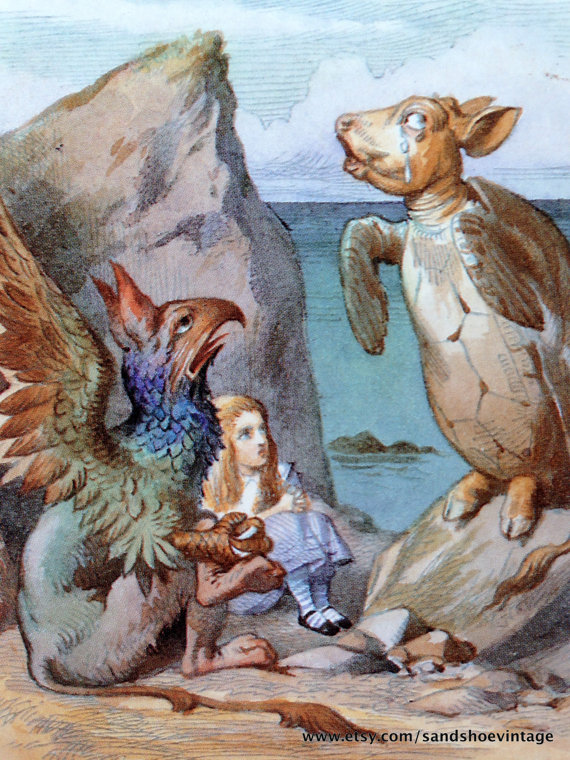


This led me to think about children's book in Britain and France (my Anglo-Saxon friends all told me that "Alice" was a delightful book - well books, with "Through the Looking Glass"-, and that they revelled in both and rather wanted to meet the characters), and British and French mythologies. 

To talk of both would take too long for such a blog but it seems that there are less fairies and elves and "little people" in French tales and myths, unless it is in Brittany - but Brittany is a Celtic country. The French are more at ease with the solar Greek and Latin/Roman myths, their gods, goddesses and minor divinities. The Gallic roots (I mean the roots of the Gauls) have been slowly erased by the Roman civilisation, itself carrying Greek traditions. The invasions from the East and North (Vandals, Visigoths, Franks et al.) did nothing to rekindle the Celtic ground. Christianity had come over the Roman gods. By the end of the fifth century, the core of what would become the Realm of France was officially Christian with the christening of the Frank King Clovis. A breach of civilisation was irredeemably dug between France and Britain.


Meanwhile, oblivious of all these more or less idle considerations, our tea party was a very reasonable one, not mad at all but greatly enjoyed. "Alice" was in my sole and only mind. Thus we all said we would make another occasion soon: so many cakes to bake and so many brands of tea to taste! 


Would we be on our way to seal the breach between "two nations" by way of tea parties?


Wednesday, 6 April 2016

Lights and shades


Spring


I have been silent from the beginning of March - more than a month without writing, more than a month without you, dear friends and readers. 

Time has elapsed and events have happened. Of course, these are daily events without great importance compared to the course of the world. Nothing like Brussels, Lahore, Syria, Ivory Coast, and other atrocities, catastrophes, wars, crises of every hue that keep happening on Planet Earth.

No. Our daily lives have been impaired, hustled, moved round but not grievously hurt.


March


First, I lost my email account, which was hacked. As the blog was somewhat linked to it, some difficulties to retrieve it, the creation of a new email account and the attempt to find back my contacts.

Then, I had a bout of  depression. Not enough sunshine and the feeling that winter, rain, darkness, clouds, damp would never come to an end. The "I have enough of all" Syndrome.

Then, when things were getting better, a nasty cold with cough and fever. 

Of course, I could not keep it all to me: I shared it with The Girls but it turned as bronchitis to Eldest One. And that was frightening because it was a very bad bout of bronchitis. At one point, I thought she would pass away.


Ill


Now, things are going back to normal. Eldest Girl is bright and sprightly, up and about, just declared perfectly fine by her doctor. There are longer times of sunshine. Cherry trees and plum trees are in bloom. The oaks are putting on tiny bronze leaves. Lilacs show bigger tender-green shoots. There are tulips in the garden and not only under the protection of walls or shrubs. Blackbirds are hopping along the house and on the lawn. There are concerts of birds morning and evening. We know that there will still  be rain (giboulées), nevertheless spring is here!


Black thorn and blue tit


It is high time to write again.

Nonetheless there will be a change in my writing blog.

This one will remain as it is: something between a diary, a chronicle of life in the country, a commonplace book of reading, art, and music, a place where to chat. 

But I have decided to create another blog, "Lights and shades", that will be dedicated to the role of caregiver, his or her life, the joys and difficulties of this function that sometimes turns out as a full time job. And the life of the "caregiven" that is sometimes sadly forgotten when he or she gets older - of course, I am thinking of my Girls here. People with Down Syndrome (commonly written DownS) are always shown as children or youngsters. What happens when they are adults and growing old? 

You may not be interested by these issues: this is why I have decided to keep two separate blogs. But you are welcome to both and a lively interaction is all I wish for. There is already a Facebook page called "Camille de Fleurville-Malaret, blogger", which you may "like", and upon which you may leave comments and reacts or send pictures, for instance. I shall create another one for "Lights and shades" where I hope that discussion will begin. We may all happen to be caregivers to our parents or members of our families. But caregivers need care themselves, and respite. I wish the new blog and the new Facebook page will be a space where to talk, weep, laugh, live together. Welcome!


Down Syndrome... What then?


Down Syndrome? Does it matter to you?


And, last, it has been now a year since I have begun to write this blog. You have read it. You have made comments. You have criticized. You have approved. Under any guise, you have been a great support: you have been here. 

Thank you.


Tuesday, 1 March 2016

A first smile for spring


daffodils

No, it is not yet spring, official spring. But there are clumps of daffodils in the garden and they are spring and well worth a smile!
We had a lovely blue sky all day with a bright sunshine, birds singing, fresh ait, I must confess, not at all a warm afternoon. But THE day where the light is more bright, where there is something in the air that shows winter is gone.
And this made me smile ... and write here for the first time!*


*This is part of a series called: "a smile a week": 


Saturday, 27 February 2016

France: a country without literature


45484_10151463466613880_1605328342_n
Madame de Pompadour as patron of arts and letters


"She" (that's your servant) "comes from a country" (France) "which has produced VERY little of what I consider literature compared to teeny British Isles!"

A short story and a big laugh about what happened to me this week.

I belong to a rather large number of reading groups or lists online. People read and discuss books and authors or books from one author. The groups and lists have various intellectual levels. I have been participating in one of these groups for more than year and became increasingly restless and angry because this was not a reading group but a super fan group worshipping an obscure British authoress who wrote some good light romantic novels, and more that are less good until, down the scale, very bad fiction that would have been better left in obscurity.
Some of her publishers agree as they let her resurrected titles slowly die again until what they hope will be extinction of the stock.
I said so.
And, tired of eternal vacillations and speculations that were coming back again and again after I had given the solution to sort out the issue last year (why and when the authoress' husband had moved from one regiment to another: the MOD has all elements and treats these questions every day) - but obviously without result -, I added some sentences about the lack of seriousness of the reading and researching - if research was really made, which I doubted - by some members of the group who made themselves leaders, while others were meekly following, a fact called the "herd phenomenon".
This started a great hulla-balloo, and, of course, I was expelled from the group, with collateral damages.
The good ladies started being - let's say - slightly paranoid, and saw me everywhere: they banned innocent people from their facebook writer fan page, thinking I was masquerading behind new aliases, all the time discussing among themselves openly - which was sad for the banned persons but awfully funny for me. I only stayed and kept quiet and read everything. Had they forgotten my real name?
They even told another group, also on facebook - group that is usually mild and very nice - whose administrators banned an impecunious Croatian lady to whom I had been talking in order to send her spare copies of books she had no money to buy. But the good American, Canadian and British ladies thought that I was talking to myself, pretending I was both an alias and the Croatian lady. They were crediting me with an agility to manoeuvre facebook, from which I would have had to log in and log out at the rhythm of a conversation! At the same time, they declared that the Croatian lady was "fishy", therefore she and I were the same and that no book should be given. "Off with our heads" - would have said the Red Queen!
I discovered I was clever, indeed. 
But the funniest thing was the note sent by one member, British and proud of it, who wrote it very seriously, to the administrators of the reading group online (not facebook), copied and pasted it and sent it again as an e-mail to one of her buddies on the list - forgetting that she was making it open to all eyes. The note included the sentence I posted at the beginning of this blog entry:
"She" (your servant) "comes from a country" (France) "which has produced VERY little of what I consider literature compared to teeny British Isles!"
Therefore, dear friends and readers, do remember: France has produced VERY little literature... Push it a little further and you may consider that this country has neither culture nor civilisation...


renoir - la liseuse verte
La Liseuse Verte (Renoir)

Tuesday, 23 February 2016

Would you like a cup of coffee or tea?


Good afternoon!


Please, come in: it is drizzling at best, raining at worst, and in between you may stand under an impromptu shower. This is a very unpleasant weather although it is mild enough for the season. But any good farmer would look quizzically at the sky, the trees, the grass growing, and ask "Which season?"

Do come in the sitting room and make yourself at ease. Give me your coat or your raincoat, and I will pour some coffee or tea - even Clipper mint tea... There is a whole array of teas from the UK, Russia and good French houses. 

It has been some time since I have not asked you to come. You may see by the untidiness of the room that we are up to something, and, yes, we are. We have planned a great overhaul of The House as soon as the sun will be here. Miss Read's readers will recognise the symptoms of spring cleaning! No Mrs Pringle but the Shopping-cum-Cleaning Lady who is training a very nice young woman. Over a cup of tea, after shopping, one Friday aternoon, we decided to unite forces and to go through the whole rooms, one after the other: five pairs of hands should be efficient. 

But we have to do something with the stacks of books that are littering every flat inch of table, armchair, sideboard, and even floor. We have cardboard boxes and sticking tape; I am trying to sort out rationally the books and magazines and pack them.

I would be glad to have most things tidy by April as we may have guests then. Best Friend from England told me yesterday over the phone that she thought about coming and visit us with her husband in April. Said husband was drinking tea with me at the same moment, smiling and nodding all the time. This is something to look forward to! Other Friends may be on their ways to visit their families and would stop en route.


Oops, here is the jug of hot water from the kitchen and some biscuits. Please, help yourself.

You may have seen that there are still crocuses, and that the winter jasmine is in full flower as well as briars. Have you noticed the clump of narcissi around the summer jasmine. Their buds are ready to explode in a flutter of white with an orange heart frilled with black. And were you to come on the North-Eastern side of the house, you would be able to watch the first primroses. Soon, there will be a whole carpet of them under the cherry trees. Readers of carissima Lucia, you will recognise Perdita's garden further West, close to the garden house. It is a remain of the efforts of a Grand-Mother who was an adept of E.F. Benson.

We had some sunshine days last week, mostly during the late afternoons. A kind Friend known online gave me some things to potter round, about English literature, and I have been reading about known authors, regional authors, and authors I did not know at all. That brought me back to Parson Woodforde and Francis Kilvert. (Decidedly, I am full of references for Miss Read's readers and Barbara Pym's). In fact, I dipped happily into Betjeman's poetry. This quiet, discreet, and reserved England, well-bred and uncomplaining, who does not exist that much any more nowadays.

I read one book about which I would like to talk with you: "English Passengers" by Matthew Kneale", and begun another: "The Master" by Com Toibin. Both are re-reads that I enjoy slowly and probably more than I did the first time I read them. More to come.


At first sight, this seems very conservative and very "gentle": it is less than it seems. Have you read these books? Did you like them?
What are you reading these days? Are you, like me, induced to be more outside, watching the flowers and listening to the birds, now that days are growing? 

However, I may be indiscreet and asking too much. Perhaps it is time for you to leave? The drizzle has ceased. The night is slowly falling. Grey swollen clouds take over the sky, but still the twitter of greenfinches sings in the fir tree near my window. Look up and you will see wild geese in formation looking like an arrow. There is a thrill of spring. If you are in the Northern hemisphere, do you feel it as well? And what does it look like in the Southern one?

Yes, sorry, so sorry: I am too talkative. I was glad to have you this afternoon. Please, do come back and let's chat again! Thank you for your being with me. You cannot begin to guess how much you are important for me!


Mr Selfridge


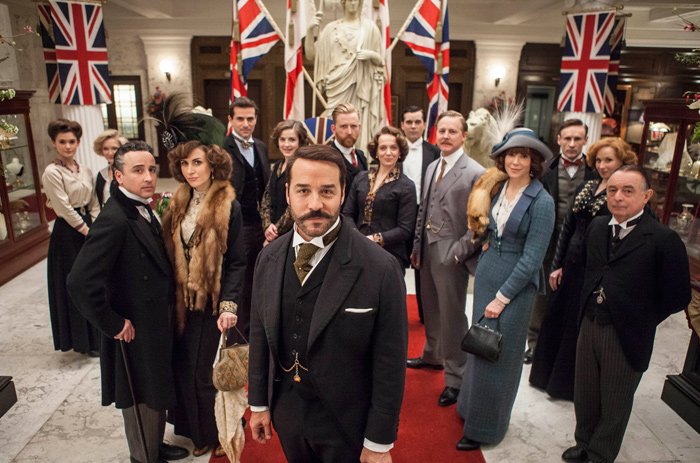
When Wolf Hall was broadcasted on the German-French channel belonging to the public service, another - private this time - channel started showing « Mr Selfridge ».

As it is a private channel, and as the audience does not have to pay to have access to it, there are of course, a great number of adverts slicing the show. And I find this very appropriate to the main topic of this series. Mr Selfridge is an American businessman come to take London by surprise and to create the first modern department store in Britain. As a businessman always searching for new events making a “buzz” around its merchandise in order to sell them more and more, Mr Selfridge could have understood that “his” series be cut thrice an episode to leave space for adverts!

I was not impressed by the first episodes. Mr Selfridge was loud. Mr Selfridge was always beaming. Mr Selfridge was talking money. Mr Selfridge was vulgar – even according to my French and twenty-first century standards.


Mr Selfridge was arriving in London having concluded a partnership that was destroyed in the first minutes of the first episode. Meanwhile, he was advertising his presence, his “store”, his methods, being photographed by the press from which he curried favours, drawing on his cigar that Frenchmen would have called a “barreau de chaise” as it was so big and ostentatious, puffing the smoke, beaming with jocundity, and all there was behind the fence was a mighty hole and no money in the bank. Tsssss! Bad American capitalist juggling with no money or others’ money.

Of course, he realised what he had come to make: he found British patrons, made his way in the demi-monde and the monde, found investors, built his department store, found employees devoted to him (I wondered why: I would have hated the guy, his methods and his culture d’entreprise avant la lettre - a corporate culture before its time –, his sense of team while he clearly remained the boss), department managers even more devoted, had an impeccable family (his devoted mother, his devoted wife, his loving children – three girls and an heir), a music-hall singer and actress who was the coqueluche of London (the toast of London) to represent the esprit (the essence) of his store, becoming his mistress. In a few words, he was a wonderful character that I hated.


It did not help that the channel that broadcasted the series was showing four episodes at a time. One comes from such a sitting with a vague sense of indigestion. Too much chocolate is too much, even if you like chocolate. What if you DON’T like chocolate?

Therefore, I hesitated to go through this half ordeal the next Friday evening, a week later, but the French TV was not showing anything suitable for The Girls and interesting for me. I resigned myself to watch Mr Selfridge again with the proviso that if I did not like it, we would switch off the TV set long before the end of the fourth episode.

I had thought about the series during the week and remembered what had been said in English-speaking newspapers and magazine: it was directed by Andrew Davies, and Andrew Davies is la crème de la crème for series; it was in direct competition with “The Paradise”, which is based upon Zola’s novel “Au Bonheur des Dames”, the founding of a department store for ladies, during the Second Empire and under the reign of Napoleon III, in Paris, based in turn upon facts, as aways with Zola: the creation of Le Bon Marché. The novel belongs to the long sequence of novels called “Les Rougon-Macquart”, which is so ill understood by English speakers who read it without, or out of, context.


And there were vague similarities with the French novel in this series as well. Mr Selfridge was as self-assured as Octave Mouret. There was a young lady seller who might have passed for Denise Baudu, were not Mr Selfridge already married. The music hall singer was not without reminding me of “Nana”. The whole department store with its déballez-moi ça, its wealth of tempting goods and its play upon the “natural wish” of “ladies” to buy, was close to the Bonheur des Dames. It seemed as frankly and openly anti-feminist and capitalist, although Zola was anti-capitalist and did not allow Octave Mouret to go through his venture unscathed. What would happen then to our Mr Selfridge?

A little research on the internet told me that he was a real person and not a fictional character (https://en.wikipedia.org/wiki/Harry_Gordon_Selfridge), and that his family was also well known (https://en.wikipedia.org/wiki/Rose_Selfridge). Therefore, Andrew Davies had to cling to facts. He usually clings to the plot of novels but here was no novel. Instead, there was a fictionalised biography by Lindy Woodhead called ”Shopping, Seduction & Mr Selfridge”. It was not a drifting scenario as “Downton Abbey” that was written to cater to the tastes of its audience and made a sort of soap opera after the first season. Unlike Fellowes, Davies had a spine for his story: the life and deeds of Henry Gordon Selfridge. Then he could embroider the facts but Davies is usually true to the periods he describes and well documented. From then onwards, it might – might, just – be less of an ordeal to watch.


 And it WAS good.

For all I know, it is still good as we entered the second season last Friday and shall be well into it this evening as I write on a Friday. The main facts are true. Then the plot has been fleshed in by “secondary” characters or fictional characters in real life who are protagonists in the series.

Yes, compared with short biographies of Harry Gordon Selfridge and Rose Selfridge, the main lines of their lives are respected. Yes, there are reminiscences of Zola in the system of the department store and in some characters or development of the plot, but they are not overwhelming. And it proves right that department stores and capitalism develop according to recurring facts and events that may be considered as patterns and axioms. One may disapprove capitalism, paternalism, corporate culture, but they existed and still exist. They are even expanding with the emergent countries such as China or the converted Russia. To demonstrate how they are born, they grow and develop, is also a way to recognise them, and to fight them if and when they go too far. Yes, there is anti-feminism: Rose and Harry are not treated equally when they are thought to have had, at least, wishful adulterous passions or consummated ones. And the music hall singer, Ellen Love, is treated as a Nana, and as a hero straight out of a play by Oscar Wilde. Yes, the suffragettes are within the store with Miss Ravilious and outside, demonstrating, and nothing shocking about their treatment is shown: the movement is less fierce than it was, the police forces and the repression are non - existent, but there is something of Marcuse’s thought in the treatment of the recuperation of the feminist movement to the benefit of both Selfridge and the store. It is unpleasant for women today and for feminists, but it did exist. Yes, the private soirée where la Pavlova danced before the Selfridges is true, but the story of Miss Towler clearly looks very much alike that of Denise Baudu.


But there are distinctive elements as well, and some are looking towards the new fashion in the English speaking series – mostly the British ones but that are loved by the Americans, Canadians and other ex-colonies or members of the British Empire. I mean the “upstairs-downstairs” trend.

There was the old “Upstairs-Downstairs”, the “Forsyte Saga”, which has undertones of the same period drama. There has been the new “Upstairs-Downstairs” that did not work well. There has been all Fellowes’ work up to “Downton Abbey”. There are now these new series that look up to the rich (and sometimes aristocratic and in any case upper-class) caste and the poor one (servants, shop sellers, secretaries, clerks, you-name-them - in any case lower class). There are your glamour and compassion for your average audience. “Gorgeous” (this is the epithet that comes again and again in the comments) costumes, lavish parties, grand houses and castles to make you dream, and male and female Cinderellas who either are allowed to grow into middle class (at least) or who stay contented with their positions. The audience is kept happy, dreaming, nostalgic, and most of the time identifying with the “upstairs” characters rather than with the “downstairs” ones, unless they are allowed to evolve socially to higher sphere. Well, there is a partial identification with the last category: they were never the “true” upper-classes”.


This is puzzling for a French person. First of all, we do not have that many costume dramas on TV, and we do not adapt our beloved authors as the English speaking countries do. There is no Balzac or Zola idolatry as there are Jane Austen, George Eliot, Charles Dickens or Anthony Trollope on pedestals with super fans. There is no real nostalgia towards the past. The past is almost always a place where the French people rebels against tyranny, not only the kings’ tyranny but also the money and the capitalist tyranny. “Germinal” (another novel by Zola) makes a large audience: it is the story of the rebellion of coal miners against employers. Aristocrats are not exalted, although the French are happy to have some sort of royal family with the Princes of Monaco – but Monaco is allowed to live because it is useful for financial reasons; it is somewhat French but not entirely; the princely family does not rule over the country and the French people; they are glamorous but slightly ridiculous as they seem to be straight out of an operetta as Ellen Love seemed to be straight out of “Nana” or an Oscar Wilde play. The French and Anglo-Saxon cultures are radically different.


Downton Abbey

Germinal


There is something more in Mr Selfridge.

It is the first British TV series I see where a Northern American character takes over the British. And a male character as that. It has made me think and look for novels by Henry James, Edith Wharton, Frances Compton-Burnett, and Constance Fennimore Coulson who is the last fashion in gender studies. Even Louisa May Alcott sends one of her “Little Women”, Amy, and her hero, Laurie, to Europe. But mostly, only women and heiresses stay in Europe to be married – rather unhappily most of the time: look at “The Buccaneers”, “The Portrait of a Lady”, “The Shuttle”, for instance. The list is not limited, there are several more titles.

Rose Selfridge is not happy in her marriage and with her life in Britain. She goes back and forth between Chicago and London. Her daughters are educated in the United States. But her son goes to an English public school from which he is seen leaving at sixteen to walk in the footsteps of his father, and come to work with him in the department store, beginning with the most menial tasks, and facing the budding trade-unions. The father, Mr Selfridge, stays in Britain and suffers the ups and downs of his own life AND those of his adopted country that he has taken by surprise.


I draw no conclusion from this: after all, I shall watch part of the second season only this evening, therefore a lot may happen. Or I shall draw a provisional conclusion. This is costume drama with a twist. There is the nostalgia of a past world but the vision of the coming end of the British Empire, its last glowing lights across the world. Soon, so soon, other countries will rise and take its place in what the British thought as the epitome of culture and civilisation. Post colonialism is here. The Barbarians are at the doors.

First of them, the Americans who will take charge. Soon, very soon.


So soon.