Showing posts with label poetry. Show all posts

Sunday, 19 June 2016

Poetry is honey for the soul (13) - Camille


         Poetry is honey for the soul


Today is Sunday and I have chosen the poem of the day.
It was mentioned once in a blog,
I looked for it and found it.
It is, for me, as a foreigner, something very English,
not British, English.
Something I would find with Anthony Trollope, with John Donne,
with John Keats, with Mrs Gaskell, with Barbara Pym.
Something Victorian and Edwardian,
a nostalgia for a past Empire today.
But was it ever idyllic and pastoral,
or is it a nostalgia for something dreamt that never was?
We have the same "faux souvenirs" in France...


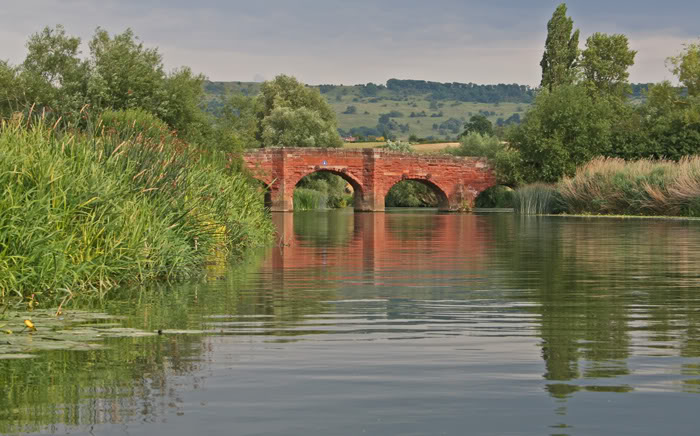
UPON ECKINGTON BRIDGE, RIVER AVON
by: A.T. Quiller-Couch

 PASTORAL heart of England! like a psalm
Of green days telling with a quiet beat--
O wave into the sunset flowing calm!
O tirèd lark descending on the wheat!
Lies it all peace beyond the western fold
Where now the lingering shepherd sees his star
Rise upon Malvern? Paints an Age of Gold
Yon cloud with prophecies of linkèd ease--
Lulling this Land, with hills drawn up like knees,
To drowse beside her implements of war?


Man shall outlast his battles. They have swept
Avon from Naseby Field to Savern Ham;
And Evesham's dedicated stones have stepp'd
Down to the dust with Montfort's oriflamme.
Nor the red tear nor the reflected tower
Abides; but yet these elegant grooves remain,
Worn in the sandstone parapet hour by hour
By labouring bargemen where they shifted ropes;
E'en so shall men turn back from violent hopes
To Adam's cheer, and toil with spade again.


Ay, and his mother Nature, to whose lap
Like a repentant child at length he hies,
Nor in the whirlwind or the thunder-clap
Proclaims her more tremendous mysteries:
But when in winter's grave, bereft of light,
With still, small voice divinelier whispering
--Lifting the green head of the aconite,
Feeding with sap of hope the hazel-shoot--
She feels God's finger active at the root,
Turns in her sleep, and murmurs of the Spring.


Friday, 17 June 2016

Poetry is honey for the soul (12) - Ellen Moody


         Poetry is honey for the soul


Ellen has already contributed to this collection of poems chosen by blogger readers for other blogger readers. Her first choice was this poem by Judith Wright:

Today she suggests two poems linked by the same theme of birds. The first is well-known as it is "The Ode to a Nightingale" by Keats, read by Stephen Fry.


The second is less known. It has been written by Fleur Adcock, originally a writer from New -Zealand. Here is her biography and bibliography:


"The Way Out"

 (by Fleur Adcock)

The other option’s to become a bird.
That’s kindly done, to guess from how they sing,
decently independent of the word
as we are not; and how they use the air
to sail as we might soaring on a swing
higher and higher; but the rope’s not there,


it’s free fall upward, out into the sky;
or if the arc veer downwad, then it’s planned:
a bird can loiter, skimming just as high
as lets him supervise the hazel copse,
the turnip field, the orchard, and then land
on just the twig he’s chosen. Down he drops


to feed, if so it be: a pretty killer,
a keen-eyed stomach weighted like a dart.
He feels no pity for the caterpillar,
that moistly munching hoop of innocent green.
It is such tender lapses twist the heart.
A bird’s heart is a tight little red bean,


untwistable. His beak is made of bone,
his feet apparently of stainless wire;
his coat’s impermeable; his nest’s his own.
The clogging multiplicity of things
amongst whch other creatures, battling, tire
can be evaded by a pair of wings.


The point is, most of it occurs below,
earthed at the levels of the grovelling wood
and gritty buildings. Up’s the way to go.
If it’s escapist, if it’s like a dream
the dream’s prolonged until it ends for good.
I see no disadvantage in the scheme.


After the celebration and joy, there has come the reality check.


Monday, 13 June 2016

Poetry is honey for the soul (11) - ML Kappa


         Poetry is honey for the soul


Marina gives us regularly news from Greece in her blog:


I follow it with the utmost assiduity: politics, economy, society, refugees, literature, Ancient Greece, Grecian Islands, myths, history, traditions -her blog is always full of information. Its full name is "Letters from Athens - A blog about life and times in Greece".
Today, she invites us to read or re-read a poem by Constantin Cavafy, which sounds oddly relevant to our times.


Constantin Cavafy


C.P. Cavafy is widely considered the most distinguished Greek poet of the twentieth century. He was born in 1863 in Alexandria, Egypt, where his Greek parents had settled in the mid-1850s. 

During his lifetime Cavafy was an obscure poet, living in relative seclusion and publishing little of his work. A short collection of his poetry was privately printed in the early 1900s and reprinted with new verse a few years later, but that was the extent of his published poetry. Instead, Cavafy chose to circulate his verse among friends. 

Cavafy was an avid student of history, particularly ancient civilizations, and in a great number of poems he subjectively rendered life during the Greek and Roman empires.

Among his most acclaimed poems is “Waiting for the Barbarians,” in which leaders in ancient Greece prepare to yield their land to barbarians only to discover that the barbarians, so necessary to political and social change, no longer exist.


Greek and Persian soldiers in a duel


WAITING FOR THE BARBARIANS


What are we waiting for, assembled in the forum?

            The barbarians are due here today.


Why isn’t anything happening in the senate?
Why do the senators sit there without legislating?

            Because the barbarians are coming today.
            What laws can the senators make now?
            Once the barbarians are here, they’ll do the legislating.


Why did our emperor get up so early,
and why is he sitting at the city’s main gate
on his throne, in state, wearing the crown?

            Because the barbarians are coming today
            and the emperor is waiting to receive their leader.
            He has even prepared a scroll to give him,
            replete with titles, with imposing names.


Why have our two consuls and praetors come out today
wearing their embroidered, their scarlet togas?
Why have they put on bracelets with so many amethysts,
and rings sparkling with magnificent emeralds?
Why are they carrying elegant canes
beautifully worked in silver and gold?

            Because the barbarians are coming today
            and things like that dazzle the barbarians.


Why don’t our distinguished orators come forward as usual
to make their speeches, say what they have to say?

            Because the barbarians are coming today
            and they’re bored by rhetoric and public speaking.


Why this sudden restlessness, this confusion?
(How serious people’s faces have become.)
Why are the streets and squares emptying so rapidly,
everyone going home so lost in thought?

            Because night has fallen and the barbarians have not come.
            And some who have just returned from the border say
            there are no barbarians any longer.


And now, what’s going to happen to us without barbarians?
They were, those people, a kind of solution.


Translated by Edmund Keeley/Philip Sherrard

(C.P. Cavafy, Collected Poems. Translated by Edmund Keeley and Philip Sherrard. Edited by George Savidis. Revised Edition. Princeton University Press, 1992)


A street of Alexandria where Cavafy was born

An example of his handwriting while writing poetry

Sunday, 12 June 2016

Poetry is honey for the soul (10) - Alison Hope


        Poetry is honey for the soul


Ali stood at an uncomfortable place last week: 
her poem was published on this blog just before my appeal to help for The Little Family. 
This was awkward and she might not have received the whole attention she deserved. 
Therefore, I post it again.


Ali is a well-known blogger, "specialised" in book reviews. She has her own blog and writes daily about a new book (better than I do and makes me feel lazy...). Here is the address:


for the few of you who would not know her yet. She is connected with books: buying books, lending books, reading groups, reviewing books, participating in book groups, in book events, creating them sometimes. I cannot imagine her without a book near at hand! Which is certainly exaggerated as she loves flowers and many other things.
When I asked her if she wanted to contribute, she asked for some days of thought, then sent me the following poem, comment and illustrations. I was surprised to see "Stopping by woods on a snowy evening" by Robert Frost that Phillip had already chosen. For the foreigner that I am it seems one of these poems that haunt you all your life long - and I begin to fall under its spell myself.


Stopping by Woods on a Snowy Evening by Robert Frost


Whose woods these are I think I know.

His house is in the village, though;

He will not see me stopping here

To watch his woods fill up with snow.

My little horse must think it queer  
To stop without a farmhouse near
Between the woods and frozen lake
The darkest evening of the year.

He gives his harness bells a shake
To ask if there is some mistake. 
The only other sounds the sweep
Of easy wind and downy flake.

The woods are lovely, dark, and deep,
But I have promises to keep,
And miles to go before I sleep, 
And miles to go before I sleep.


There were lots of poems I could (nearly did) choose for this, many deeper, seemingly more complex pieces than this. Yet I kept coming back to this poem, one I first heard probably as a child. I love the deceptive simplicity of the poem, yet the images it evokes remain, and tell a story – albeit a simple one. The reader is left wondering about where the traveller might be going – what are those promises – and to whom were they made?

The poem reminds me -always of my dad – he died eight years ago. I can remember him quoting – on several occasions, though what those occasions were I can’t recall – that final haunting stanza – so it is a poem I always associate with him. 


Monday, 6 June 2016

Poetry is honey for the soul (10) - Alison Hope


        Poetry is honey for the soul


Ali is a well-known blogger, "specialised" in book reviews. She has her own blog and writes daily about a new book (better than I do and makes me feel lazy...). Here is the address:


for the few of you who would not know her yet. She is connected with books: buying books, lending books, reading groups, reviewing books, participating in book groups, in book events, creating them sometimes. I cannot imagine her without a book near at hand! Which is certainly exaggerated as she loves flowers and many other things.
When I asked her if she wanted to contribute, she asked for some days of thought, then sent me the following poem, comment and illustrations. I was surprised to see "Stopping by woods on a snowy evening" by Robert Frost that Phillip had already chosen. For the foreigner that I am it seems one of these poems that haunt you all your life long - and I begin to fall under its spell myself.


Stopping by Woods on a Snowy Evening by Robert Frost


Whose woods these are I think I know.

His house is in the village, though;
He will not see me stopping here
To watch his woods fill up with snow.

My little horse must think it queer  
To stop without a farmhouse near
Between the woods and frozen lake
The darkest evening of the year.

He gives his harness bells a shake
To ask if there is some mistake. 
The only other sounds the sweep
Of easy wind and downy flake.

The woods are lovely, dark, and deep,
But I have promises to keep,
And miles to go before I sleep, 
And miles to go before I sleep.


There were lots of poems I could (nearly did) choose for this, many deeper, seemingly more complex pieces than this. Yet I kept coming back to this poem, one I first heard probably as a child. I love the deceptive simplicity of the poem, yet the images it evokes remain, and tell a story – albeit a simple one. The reader is left wondering about where the traveller might be going – what are those promises – and to whom were they made?

The poem reminds me -always of my dad – he died eight years ago. I can remember him quoting – on several occasions, though what those occasions were I can’t recall – that final haunting stanza – so it is a poem I always associate with him. 


Thursday, 2 June 2016

Poetry is honey for the soul (9) - Ellen Moody


           Poetry is honey for the soul


Ellen Moody is ... Well, I could write a classic introductory note telling you all about the academic career of Professor Moody, her achievements, diplomas, curriculum vitae. But you will find all this on the net (http://www.jimandellen.org/ellen/emmorlif.htm).  Ellen is someone "from the family" for me, in a way, although we have never met. My God-mother "met" her while discussing in one of Ellen's numerous reading groups on the net, and I sort of went on discussing in the same groups some years later. In this indirect way, I have been taught a lot.

But Ellen is closer than that. She writes me off line emails, talks about her family, her life, her daughter Isobel, sends recommendations about what to read, photos of her garden and her two cats, Ian and Clary, ceases to be Professor Moody to be simply (what a reductive word !) Ellen.

Links to her various blogs are given at the end of this post.


When I asked her if she would contribute and give us a poem, this is what Ellen wrote: 


"It's common for women to write of small creatures -- and to identify. Women especially have written bird poems.  Here are two of my favorite poets and two bird poems by them for your blog: both are 20th century poets, Judith Wright, Australian, Fleur Adcock, originally a New Zealander."

I chose Judith Wright poem (this time).

"I love Australian literature, art, history, the landscape, and am persuaded the angle on reality that Wright’s background gave her is part of why I love her poetry. And the tone of her mind. Her typical imagery. The rhythms of the lines."


Extinct Birds
Charles Harpur in his journals long ago
(written in hope and love, and never printed)
recorded the birds of his time’s forest —
birds long vanished with the fallen forest —
described in copperplate on unread pages.


The scarlet satin-bird, swung like a lamp in berries,
he watched in love, and then in hope described it,
There was a bird, blue, small, spangled like dew.
All now are vanished with the fallen forest.
And he, unloved, past hope, was buried,


who helped with proud stained hands to fell the forest,
and set those birds in love on unread pages;
yet thought himself immortal, being a poet.
And is he not immortal, where I found him,
in love and hope along his careful pages? —
the poet vanished, in the vanished forest,
among his brightly tincted extinct birds? 


This a blog written by Ellen about Judith Wright 
with references to other material 

Wednesday, 1 June 2016

Poetry is honey for the soul (8) - Hammad Rais


           Poetry is honey for the soul


Hammad Rais is a blogger I met "by accident" in the blogosphere. I think we were under the same tutorship of Wordpress, and he came to my rescue because I had not understood something - as usual. Hammad is from Pakistan, Karachi to be more precise. As months have passed, I have met his family, his parents, parents-in-law, his "lovely wife, Jia" (this is how he introduced her to me), their son Uzair who has just started going to his first school - a Montessori school - and whom I consider as an honorary nephew (!!!); we have worked on some posts together, Hammad and I, to make his country known by Westerners; we have exchanged e-mails, re-blogged and tweeted each other's blogs.

Hammad is well known by the Wordpress community. I do invite you warmly to have a look at this blog (of which I give the link at the end of this post). You will discover another way of life and at the same time our same fundamental way(s) of life and values. In times of non-understanding and violent refusal between the West and the East, it is the beginning of a healing process to go, read, comment, exchange with the One who seems on the other side of a breach. 

Only to state that we are essentially the same.

Hammad blogs about his life life in Pakistan, photography, memories, poetry... I have chosen one of his last "attempts" as he calls them: he says he is no poet but words sometimes bubble this way and no other! 


BRICK BY BRICK

We build up our lives too
Just like our homes

There is a kitchen
Where we make dreams and hopes

A living room which is,
Full of happiness and joy, for everyone

Basement is underground
To store up the memories, good and bad, both

Lawn in front
To plant the future of us and our generations

We have washrooms too
To cleanse ourselves from life’s hardships

A Reading room
To learn not only about ourselves but also about the world.


WP_000134


This is a photograph of Hammad's home (light and shades),
also published on his blog.
And here is the link to his blog: 
(All texts and images protected by laws and regulations of copyright)